


within the metallic assembly through which the fluid circulates, providing temperature control and high energy efficiency.
In the plastics processing industry, heat plays a role in several production stages: polymer melting and plasticization inside extruders, die temperature control, heated rollers, calenders, lamination and coating equipment, tanks, and reactors.
However, the same heating technology is not necessarily used throughout an entire manufacturing facility.
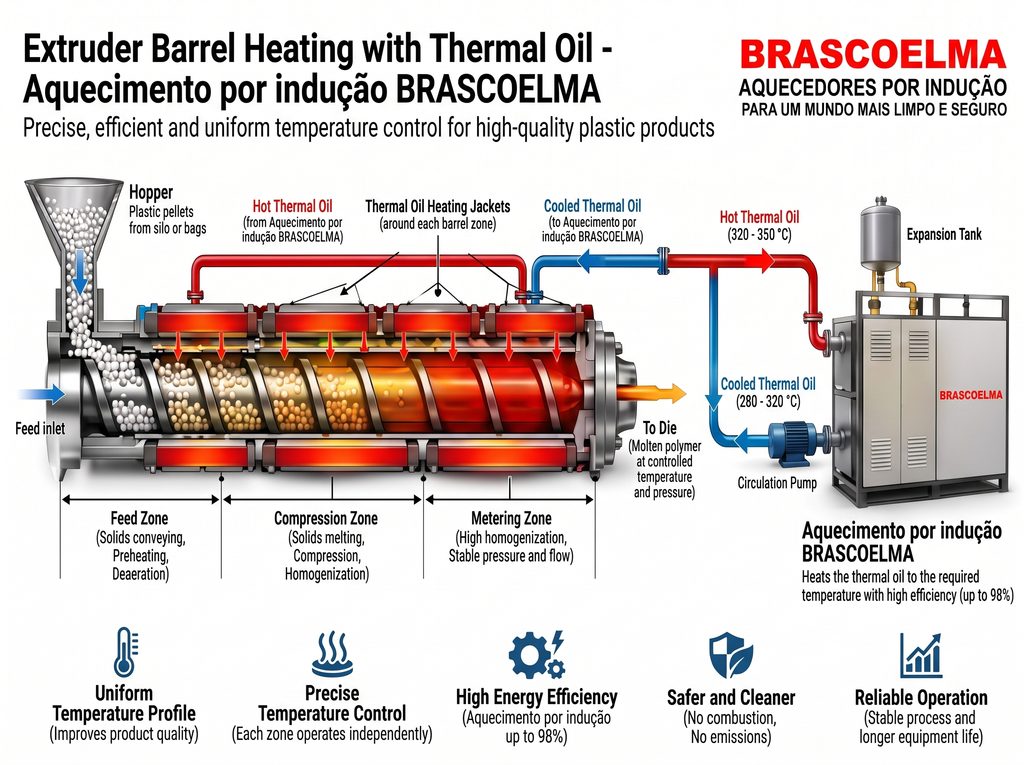
Extruder barrels generally use band heaters, ceramic heating elements, or other electrically heated zones.
On the other hand, many plastic film and flexible packaging manufacturers use thermal fluid circuits to deliver controlled heat to rollers, calenders, laminators, coating units, tanks, and reactors.
This is where Direct Electromagnetic Induction Fluid Heating (ADFIE) becomes particularly relevant.
Instead of generating heat through combustion or conventional electrical resistance elements, ADFIE uses electromagnetic induction to heat a metallic assembly and transfer thermal energy directly to the circulating fluid.
For facilities that already use thermal oil, the technology can be evaluated as a central heat source supplying the existing circuit, subject to an engineering assessment.
WHAT IS DIRECT ELECTROMAGNETIC INDUCTION FLUID HEATING (ADFIE)?
ADFIE — Direct Electromagnetic Induction Fluid Heating — is a technology that uses electrical energy to generate heat within the metallic tubes of a heating assembly through which the process fluid circulates.
Its fundamental electromagnetic operating principle is similar to that of an electrical transformer.
Electrical energy powers the induction coils, creating an alternating electromagnetic field.
This field induces electrical currents within the metallic heating tubes, causing the tube walls themselves to generate heat.
Meanwhile, the fluid circulates continuously through the assembly and absorbs thermal energy.
As a result, the system heats the fluid without requiring a flame, combustion chamber, intermediate steam system, or conventional electrical resistance heating elements in contact with the fluid.
HOW IS ENERGY TRANSFERRED IN THE ADFIE SYSTEM?
Energy transfer sequence in ADFIE.
The fluid enters the heater at the required pressure and flow rate, circulates through the tube bundle, progressively absorbs heat, and exits at the specified temperature.
An important characteristic of this principle is the ability to control the temperature difference between the tube wall and the circulating fluid.
Combined with continuous fluid movement, this characteristic makes it possible to design a more uniform temperature distribution and reduce conditions that promote localized overheating.
WHERE IS HEAT USED IN PLASTIC FILM AND FLEXIBLE PACKAGING PRODUCTION?
An extruder typically contains several temperature zones.
Polymer pellets are conveyed by the screw through the heated barrel, where they are melted and homogenized before reaching the die.
Depending on the process and machine design, heat may be supplied by electric heaters, thermal oil, or a combination of heating and cooling.
MAIN APPLICATIONS OF THERMAL FLUIDS IN THE PLASTICS INDUSTRY
| INDUSTRIAL APPLICATION | USE OF HEAT |
|---|---|
| Heated rollers | Roller temperature control |
| Calenders and finishing rollers | Controlled heating during processing |
| Laminators | Heat supply for the lamination process |
| Coating and adhesive systems | Thermal control during application stages |
| Resin and adhesive tanks | Heating contents according to process requirements |
| Reactors and jacketed vessels | Heat transfer through thermal fluid circuits |
| Central thermal oil circuits | Heat distribution to different equipment |
| Selected extrusion and die systems | Heating when specifically designed for thermal fluid operation |
Thermal oil can provide stable and uniform heat distribution across a broad temperature range.
However, not all machines use this type of circuit.
For this reason, ADFIE should primarily be evaluated for applications where fluid heating is technically appropriate.
WHAT ARE THE CONVENTIONAL HEATING TECHNOLOGIES USED IN THE PLASTICS INDUSTRY?
ELECTRIC RESISTANCE HEATERS
Band heaters, mica heaters, and ceramic heating elements are widely used on extruder barrels.
These elements provide localized heating and are established technologies in plastics processing.
Some ceramic heating elements have element or surface temperature ratings ranging from 500°C to 700°C (932°F to 1,292°F).
However, this does not mean the polymer is processed at those temperatures.
Actual processing temperatures depend on the material, polymer grade, and machine specifications.
STEAM SYSTEMS
Steam can be used as an industrial heat transfer medium.
However, its application requires a steam source, water treatment, distribution infrastructure, condensate management, and auxiliary equipment.
When the process uses thermal oil, an additional heat exchanger may be necessary.
COMBUSTION-BASED SYSTEMS
Gas-fired, diesel-fired, and other fuel-based systems can supply large amounts of heat.
However, they require burners, combustion controls, exhaust systems, and safety and maintenance infrastructure.
They also generate combustion emissions at the heat generation source.
ADFIE VS. CONVENTIONAL HEATING: WHAT ARE THE DIFFERENCES?
| CRITERION | ELECTRIC RESISTANCE | STEAM OR COMBUSTION | ADFIE |
|---|---|---|---|
| Heat generation | Resistance heating element | Boiler, burner, or heat exchanger | Electromagnetic induction |
| Thermal fluid heating | May use resistance elements | May require a heat exchanger | Direct heating within the assembly |
| Combustion | No | Depends on the system | No combustion within the heater |
| Maintenance | May include resistance element replacement | Burner, boiler, and auxiliary systems | Electrical, electronic, and auxiliary components |
| Thermal response | Depends on thermal mass and controls | Depends on system inertia | Designed for rapid response |
| Localized overheating | Depends on heat flux and geometry | Depends on design | Designed to reduce hot spots |
| Temperature control | With appropriate controls | With appropriate controls | Electrical power modulation |
| Emissions at the heater | No combustion | Depends on fuel | No combustion |
This comparison is qualitative.
The appropriate choice depends on the required temperature, thermal load, operating hours, electricity and fuel costs, existing infrastructure, and safety requirements.
WHY ARE WALL TEMPERATURE AND FILM TEMPERATURE IMPORTANT IN THERMAL OIL HEATING?
There is no single maximum temperature applicable to all thermal oils.
The limit depends on the fluid’s chemical composition, system design, and operating conditions.
Two parameters are particularly important:
Average fluid temperature: The temperature of the circulating oil, used to characterize its operating condition.
Film temperature: The local fluid temperature adjacent to the heating surface, which may be higher than the average temperature.
When film temperature becomes excessively high, conditions may develop that promote thermal degradation, fouling, and deposit formation.
For this reason, system design must account for flow velocity, temperature distribution, and heat transfer.
TECHNICAL EXAMPLE: THERMAL OIL AT 320°C
The study uses a representative high-temperature synthetic fluid similar to Therminol VP-1, consisting of a eutectic mixture of biphenyl and diphenyl oxide.
For the analyzed condition, a temperature difference of 25°C (45°F) between the wall and the fluid was assumed.
REPRESENTATIVE DESIGN CONDITIONS
320°C
Fluid outlet temperature
25°C
Assumed temperature difference
345°C
Wall/film temperature
Values used as assumptions in the technical study, not universal results for every ADFIE installation.
Under these conditions, controlling wall temperature is an important factor in reducing conditions that promote fluid degradation.
However, actual temperatures depend on power, geometry, flow rate, oil properties, fouling, and control systems.
HOW CAN LOCALIZED OVERHEATING ACCELERATE THERMAL OIL DEGRADATION?
The thermal degradation of carbon-based fluids can be influenced by temperature and exposure time.
The study uses an analysis based on the Arrhenius equation, which relates temperature to the rate of certain chemical processes.
Using an assumed activation energy of 180 kJ/mol, relative degradation and coking indices were calculated.
Relative degradation/coking index — illustrative model
0×45×90×135×180×345°C375°C400°C430°C450°C
Illustrative Arrhenius comparison; reference at 345°C = 1×. These are not field-measured degradation rates.
The results demonstrate the strong influence of local temperature on the relative degradation tendency within the model used.
These indices do not represent field-measured coking rates, nor do they independently prove the comparative performance of commercial equipment.
Their purpose is to demonstrate why avoiding unnecessarily high surface temperatures can be important for preserving thermal fluids.
Specific degradation mechanisms, kinetic parameters, and critical temperatures vary according to each fluid’s chemical composition.
WHAT TEMPERATURE RANGES ARE CONSIDERED FOR ADFIE APPLICATIONS?
The technical study presents practical temperature ranges for evaluating induction heating opportunities.
| TEMPERATURE | CATEGORY | APPLICATIONS AND CONDITIONS |
|---|---|---|
| 150–250°C | Common process range | Conventional thermal oils, rollers, calenders, tanks, and reactors |
| 250–320°C | Highly relevant range | High-quality mineral and synthetic fluids; plastics and polymer processes |
| 320–360°C | High temperature | Selected synthetic fluids and application-specific engineering |
| 360–400°C | Specialized range | Specific fluid selection, circulation, expansion, pressure, materials, and safety requirements |
These ranges represent potential applications for evaluation, not universal operating limits.
The maximum permissible temperature depends on the fluid and system engineering.
WHAT ARE THE MAIN BENEFITS OF ADFIE FOR THERMAL OIL SYSTEMS?
HIGH ELECTRICAL-TO-THERMAL CONVERSION EFFICIENCY
ADFIE was developed to convert electrical energy into useful thermal energy efficiently.
The technical study describes properly designed installations achieving conversion efficiencies approaching 98% under defined operating conditions.
However, overall system efficiency also depends on pumps, insulation, controls, and distribution.
DIRECT FLUID HEATING
Heat is generated within the metallic assembly through induction and transferred to the circulating fluid.
This eliminates the need for a combustion chamber within the heater and may eliminate certain intermediate heat transfer stages.
REDUCED RISK OF LOCALIZED OVERHEATING
Heat transfer is designed to control wall temperature and the temperature difference between the wall and the fluid.
Proper flow rate sizing and temperature limits remain essential.
RAPID THERMAL RESPONSE
The heating assembly’s low thermal inertia allows rapid response to changes in process demand compared with certain systems having greater thermal mass.
PRECISE TEMPERATURE CONTROL
Electrical power can be modulated to meet process requirements.
This allows outlet temperature to be controlled according to the instrumentation and control strategy employed.
REDUCED MAINTENANCE
The heater does not use a burner or conventional electrical resistance heating elements.
However, electronic components, instruments, pumps, and auxiliary systems still require maintenance.
NO COMBUSTION WITHIN THE HEATER
There is no flame or combustion at the point of heat generation.
This eliminates direct combustion emissions from the heater itself.
COMPACT INSTALLATION AND CONTINUOUS OPERATION
ADFIE can be evaluated as a central heater located near the process or integrated into an existing thermal oil circuit.
The technology can also be designed for continuous industrial operation, provided it is properly sized and operated.
HOW CAN ADFIE REPLACE A CENTRAL HEAT SOURCE IN A FLEXIBLE PACKAGING FACTORY?
Consider a plastic film or flexible packaging factory with an illustrative thermal demand between 1,000 and 2,000 kW in its thermal oil circuit.
The existing system may use a thermal oil boiler or an electric resistance heater.
In a conventional combustion-based system, energy follows this sequence:
Fuel → Burner → Thermal Oil Heater → Pump → Distribution → Rollers, Calender, Laminator, and Tanks → Return
With the ADFIE concept, the sequence becomes:
Electricity → ADFIE → Hot Thermal Oil → Pump → Distribution → Rollers, Calender, Laminator, and Tanks → Return
The objective is not necessarily to replace every electric heater installed on the production machinery.
In many facilities, the opportunity lies in replacing or modernizing the central heat source supplying the thermal oil circuit.
In this scenario, heat-consuming equipment and its controls may remain substantially unchanged, subject to a detailed engineering assessment.
WHICH PLASTICS MANUFACTURERS CAN BENEFIT FROM ADFIE?
The most relevant opportunities are found in facilities that use thermal oil circuits or where a centralized thermal fluid system is technically appropriate.
Industries identified in the study include:
- PE, PP, PET, and multilayer plastic film manufacturers;
- Flexible packaging producers;
- BOPP and BOPET film manufacturers;
- Calendering operations;
- Lamination and coating facilities;
- Polymer and resin producers;
- Plastic compound and masterbatch manufacturers using thermal fluid systems;
- Facilities with heated rollers and large process tanks;
- Factories operating continuously or for extended annual operating hours;
- Facilities using gas-fired, diesel-fired, or other fuel-based heaters.
The main question for a facility that already uses thermal oil is:
Can ADFIE replace or improve the central heat source supplying our thermal oil circuit?
This assessment must consider the actual thermal demand and installation configuration.
CAN ADFIE BE USED WITH OTHER INDUSTRIAL FLUIDS?
Yes. The induction heating principle can be applied to different liquids and gases, depending on the design.
The technical study presents applications involving thermal oils, mineral and synthetic oils, petroleum-derived liquids, fuels, hydrocarbons, natural gas, nitrogen, and process gases.
This versatility is particularly relevant for temperature-sensitive fluids or those susceptible to thermal degradation.
However, every fluid has its own properties.
Therefore, extending conclusions obtained from thermal oil applications to other products requires specific validation of operating conditions, materials, and degradation mechanisms.
CAN INDUCTION HEATING SUPPORT INDUSTRIAL DECARBONIZATION?
Electrification of industrial heating can be part of strategies focused on energy efficiency and emissions reduction.
ADFIE uses electricity and does not produce combustion gases within the heater itself.
When technically and economically feasible, it may replace or complement systems based on fossil fuels, steam generation, or conventional electrical resistance heating.
However, the environmental benefit depends on the electricity source and the facility’s overall energy balance.
The absence of combustion within the heater does not, by itself, mean that the process has no associated emissions.
WHAT IS THE RELATIONSHIP BETWEEN ADFIE, ENERGY, AND EXERGY?
Energy is conserved according to the First Law of Thermodynamics.
However, not all energy has the same capacity to perform useful work.
Exergy represents the maximum useful work theoretically available when a system reaches equilibrium with its reference environment.
Anergy corresponds to the portion of energy that cannot be converted into useful work under those conditions.
Conceptually:
\[ \text{Energy}=\text{Exergy}+\text{Anergy} \]
In industrial heating, the objective should not simply be to supply a certain amount of energy.
It is also important to deliver heat to the process at the required temperature and location while minimizing avoidable losses.
ADFIE converts electrical energy into heat through electromagnetic induction within the heating assembly, transferring that energy to the circulating fluid.
WHAT SHOULD BE VERIFIED BEFORE SELECTING AN ADFIE HEATER?
Equipment selection requires information about the process and the existing system.
| PARAMETER | REQUIRED INFORMATION |
|---|---|
| Thermal power | Demand in kW or kcal/h |
| Fluid | Type of thermal oil and its current condition |
| Temperatures | Inlet, outlet, and fluid and film temperature limits |
| Flow rate | Circulation required by the process |
| Pressure | Operating conditions and expansion tank |
| Piping | Dimensions, pump, and pressure drop |
| Operating schedule | Operating hours and annual utilization |
| Existing system | Type and efficiency of the current heater |
| Electrical power | Availability and voltage |
| Control | Temperature stability requirements |
| Safety | Applicable requirements, such as ATEX, CE, PED, or SIL |
| Redundancy | Operational continuity requirements |
| Insulation | Condition and distribution losses |
Final selection must be based on a specific thermal and mechanical engineering design.
ADFIE is not a universal heater. It is a solution developed according to the fluid, temperature, flow rate, pressure, and process requirements of each installation.
WHAT IS THE HISTORY OF DIRECT ELECTROMAGNETIC INDUCTION FLUID HEATING?
The origins of ADFIE date back to 1983, when Dr. Ing. MSc. Mario Di Giulio pioneered the development of a system for direct electromagnetic induction fluid heating.
At that time, conventional electrical resistance heaters, steam systems, and combustion-based technologies predominated in many industrial heating applications.
ADFIE introduced a different approach: generating heat through electromagnetic induction directly within the metallic assembly through which the fluid circulates.
Its development involved engineering calculations, thermal analyses, practical experimentation, and the creation of specialized sizing methods.
Experimental prototypes were subsequently developed and validated.
Over the following decades, the technology expanded to include applications involving industrial liquids and gases.
The fundamental principle remains:
Electrical Energy → Electromagnetic Induction → Heated Metallic Surface → Process Fluid
FAQ — DIRECT ELECTROMAGNETIC INDUCTION FLUID HEATING
WHAT DOES ADFIE STAND FOR?
ADFIE stands for Direct Electromagnetic Induction Fluid Heating. The technology uses induction to generate heat within the metallic assembly through which the fluid circulates.
IS ADFIE AN ELECTRIC RESISTANCE HEATER?
No. Heat is generated through electromagnetic induction within the metallic assembly, without conventional electrical resistance heating elements in contact with the fluid.
CAN ADFIE HEAT THERMAL OIL?
Yes. Thermal oil heating is one of its applications, particularly in industrial heat transfer circuits.
CAN ADFIE BE USED IN THE FLEXIBLE PACKAGING INDUSTRY?
Yes, particularly in facilities with thermal oil circuits supplying calenders, laminators, heated rollers, and other equipment.
DOES ADFIE REPLACE ALL THE HEATING ELEMENTS IN AN EXTRUDER?
Not necessarily. In many factories, the main opportunity lies in replacing the central heat source supplying the thermal oil circuit.
WHAT IS ADFIE’S EFFICIENCY?
The technical study reports electrical-to-thermal conversion efficiencies approaching 98% in properly designed installations under defined operating conditions. Actual efficiency depends on the equipment and operating conditions.
DOES ADFIE REDUCE THERMAL OIL DEGRADATION?
The system can be designed to control the temperature difference between the wall and the fluid, reducing conditions that promote localized overheating. Results depend on the fluid and system design.
CAN ADFIE OPERATE AT 400°C?
The study considers specialized applications in the 360°C to 400°C range, subject to appropriate fluid selection, materials, circulation, pressure, and safety requirements.
DOES ADFIE USE GAS OR COMBUSTION?
No. The technology uses electrical energy and electromagnetic induction, without combustion within the heater itself.
CAN ADFIE BE INTEGRATED INTO AN EXISTING THERMAL OIL CIRCUIT?
Yes. Engineering teams can evaluate this possibility by considering power requirements, temperatures, flow rate, pressure, infrastructure, and existing controls.
INDUCTION HEATING FOR THE PLASTICS INDUSTRY: ENGINEERING THAT DELIVERS HEAT WHERE THE PROCESS NEEDS IT
The plastics industry uses different heating technologies, each suited to specific process conditions.
Electrical resistance heaters remain important for localized heating zones within production machinery.
However, centralized thermal oil circuits present a different opportunity.
ADFIE — Direct Electromagnetic Induction Fluid Heating — generates heat within the metallic assembly through which the fluid circulates, providing temperature control, rapid thermal response, and combustion-free operation within the heater.
Its application must account for fluid characteristics, thermal demand, flow rate, pressure, and operating conditions.
BRASCOELMA brings more than 50 years of experience in engineering and industrial induction heating solutions.
Does your plastic film, flexible packaging, lamination, or calendering facility use a centralized thermal oil circuit?
Contact BRASCOELMA’s engineering team and request a technical assessment to evaluate the application of ADFIE in your industrial process.